
The Modern Movement Housing in Varadero
Keywords:
Housing formal variants Modern Movement domestic architecture VaraderoAbstract
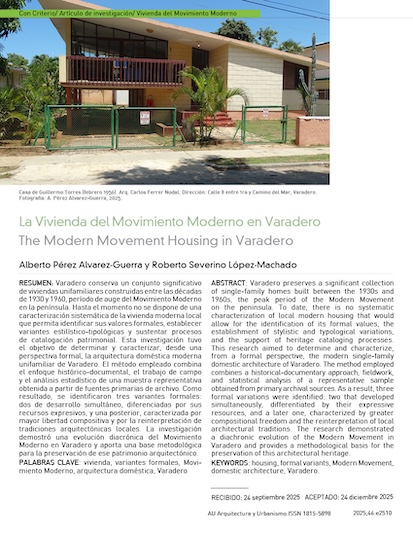
Varadero preserves a significant collection of single-family homes built between the 1930s and 1960s, the peak period of the Modern Movement on the peninsula. To date, there is no systematic characterization of local modern housing that would allow for the identification of its formal values, the establishment of stylistic and typological variations, and the support of heritage cataloging processes. This research aimed to determine and characterize, from a formal perspective, the modern single-family domestic architecture of Varadero. The method employed combines a historical-documentary approach, fieldwork, and statistical analysis of a representative sample obtained from primary archival sources. As a result, three formal variations were identified: two that developed simultaneously, differentiated by their expressive resources, and a later one, characterized by greater compositional freedom and the reinterpretation of local architectural traditions. The research demonstrated a diachronic evolution of the Modern Movement in Varadero and provides a methodological basis for the preservation of this architectural heritage.
References
Santamaría N. Varadero. El valor patrimonial de su Arquitectura. En: Gómez Consuegra L, Niglio O, editores. Conservación de centros históricos en Cuba. Vol. 2. Roma: Aracne Editrice; 2015. p. 703–725 [consultado: 10 septiembre 2025]. Disponible en: https://dialnet.unirioja.es/servlet/articulo?codigo=5241016
López Machado RS, coord. Las Villas y Matanzas. Guía de Arquitectura y Paisaje. Sevilla: Junta de Andalucía y Asambleas del Poder Popular de Sancti Spíritus, Matanzas, Cienfuegos y Villa Clara; 2012.
Rodríguez EL, ed. La Arquitectura del Movimiento Moderno. Selección de Obras del Registro Nacional. La Habana: Ediciones Unión; 2011.
Recondo Pérez RF. Varadero, ayer y hoy. Revista de Arquitectura e Ingeniería[Internet]. 2010[consultado: 15 de septiembre de 2025]:4(3). Disponible en: https://www.redalyc.org/articulo.oa?id=193915950003
López Machado RS. Evolución de la arquitectura doméstica de Santa Clara desde su fundación hasta 1945 [tesis doctoral]. Santa Clara: Universidad Central “Marta Abreu” de Las Villas; 1992.
Rossi A. La arquitectura de la ciudad. Barcelona: Gustavo Gili; 1982.
Frampton K. Towards a criticalregionalism: sixpointsforanarchitecture of resistance. En: Foster H, editor. The anti-aesthetic: essaysonpostmodern culture. Seattle: BayPress; 1983. p. 16-30.
Giedion S. Espacio, tiempo y arquitectura. Barcelona: Reverté; 2009.
Weiss JE. La arquitectura colonial cubana. Siglo XVI al XIX. La Habana-Sevilla: Instituto Cubano del Libro; 1996. Disponible en: https://archive.org/details/laarquitecturaco0000weis/page/n7/mode/2up
Batista E. La casa cubana: patios, portales y persianas. Artes Plásticas. 1960; (2):4–7.
Segre R. Arquitectura y urbanismo de la Revolución Cubana. La Habana: Pueblo y Educación; 1989..
Coyula M. La Habana: espacios y memorias. La Habana: Científico-Técnica; 2001.
Rodríguez EL. TheHavanaGuide: Modern Architecture 1925–1965. New York: Princeton ArchitecturalPress; 2000.
Segre R, Cárdenas E, Aruca L. Historia de la Arquitectura y del Urbanismo: América Latina y Cuba. La Habana: Pueblo y Educación; 1986.
Rouco Méndez AJ. La obra de Raúl Álvarez y Enrique Gutiérrez en los repartos del sur de La Habana. Arquitectura y Urbanismo [Internet]. 2018 [consultado: 5 de septiembre de 2025]; 39(3):18-31. Disponible en: https://rau.cujae.edu.cu/index.php/revistaau/article/view/505
Rouco Méndez AJ, Muñoz Hernández R. Re-descubrir el Movimiento Moderno desde un ejercicio docente. Arquitectura y Urbanismo [Internet]. 2020 [consultado: 10 de septiembre de 2025]; 41(1):120-131. Disponible en: https://rau.cujae.edu.cu/index.php/revistaau/article/view/572
Rouco Méndez AJ, Matamoros Tuma MR. La arquitectura residencial del Movimiento Moderno en los repartos del municipio Cerro (1950-1964). Arquitectura y Urbanismo [Internet]. 2022 [consultado: 18 de junio de 2025]; 43(1):19-39. Disponible en: https://rau.cujae.edu.cu/index.php/revistaau/article/view/665
Febles Trujillo AE. La arquitectura residencial del Movimiento Moderno en la ciudad de Matanzas [tesis de grado en Arquitectura]. La Habana: Universidad Tecnológica de La Habana José Antonio Echeverría, Cujae, 2022.
Roth LM. Entender la Arquitectura: sus elementos, historia y significado. Barcelona: Gustavo Gili; 1999.
Companioni Román EV. Evolución de la arquitectura doméstica de veraneo en la ciudad de Varadero de carácter estilístico tipológico: Madera Vernácula, Art-Decó y Movimiento Moderno Racionalista Tradicional, Evolucionado y Vanguardista [tesis de grado en Arquitectura]. Santa Clara: Universidad Central Marta Abreu de las Villas, 2025.
Méndez Valdivia DR. Evolución de la arquitectura doméstica en la ciudad de Varadero en los estilos: Neocolonial y Movimiento Moderno con techos inclinados [tesis de grado en Arquitectura]. Santa Clara: Universidad Central Marta Abreu de las Villas, 2025.
Varadero (Cárdenas) [Internet]. Ecured; 2025 [consultado: 10 de julio de 2025]. Disponible en: https://www.ecured.cu/Varadero_(C%C3%A1rdenas)
Street G. An account of Irénée Du Pont’s Investment in the Hicacos Peninsula near Varadero, Cuba together with General Pertinent Cuban Information. 1944. [Manuscrito inédito]. Consultado en Museo Oscar María de Rojas de Cárdenas.
Downloads
Published
How to Cite
Issue
Section
License

This work is licensed under a Creative Commons Attribution-NonCommercial-NoDerivatives 4.0 International License.
a. The authors retain the copyright and guarantee the magazine the right to be the first publication of the work as well as a Creative Commons Attribution License that allows others to share the work with an acknowledgment of the authorship of the work and the initial publication in this magazine.
b. Authors may separately establish additional agreements for the non-exclusive distribution of the version of the work published in the journal (for example, place it in an institutional repository or publish it in a book), with an acknowledgment of its initial publication in this journal.
c. Authors are allowed and encouraged to disseminate their work electronically (for example, in institutional repositories or on their own website) before and during the submission process, as it can lead to productive exchanges, as well as a more early and major published papers (See The Effect of Open Access, in English).
