
Formation of Creative Thinking in Architecture Students in Cuba
Dialogue with a Young Graduate
Keywords:
Creativity creative thinking architectural design architectural design education academic supervision.Abstract
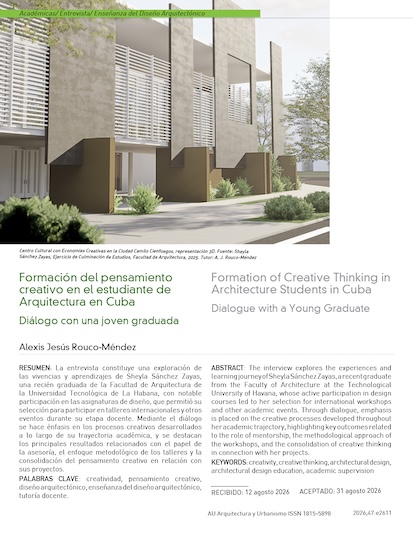
The interview explores the experiences and learning journey of Sheyla Sánchez Zayas, a recent graduate from the Faculty of Architecture at the Technological University of Havana, whose active participation in design courses led to her selection for international workshops and other academic events. Through dialogue, emphasis is placed on the creative processes developed throughout her academic trajectory, highlighting key outcomes related to the role of mentorship, the methodological approach of the workshops, and the consolidation of creative thinking in connection with her projects.
Downloads
Published
2026-09-15
How to Cite
Rouco-Méndez , A. J. (2026). Formation of Creative Thinking in Architecture Students in Cuba: Dialogue with a Young Graduate. Revista científica De Arquitectura Y Urbanismo, 47, e2611. Retrieved from https://rau.cujae.edu.cu/index.php/revistaau/article/view/910
Issue
Section
Academics
License

This work is licensed under a Creative Commons Attribution-NonCommercial-NoDerivatives 4.0 International License.
The authors who publish in this journal agree with the following terms:
a. The authors retain the copyright and guarantee the magazine the right to be the first publication of the work as well as a Creative Commons Attribution License that allows others to share the work with an acknowledgment of the authorship of the work and the initial publication in this magazine.
b. Authors may separately establish additional agreements for the non-exclusive distribution of the version of the work published in the journal (for example, place it in an institutional repository or publish it in a book), with an acknowledgment of its initial publication in this journal.
c. Authors are allowed and encouraged to disseminate their work electronically (for example, in institutional repositories or on their own website) before and during the submission process, as it can lead to productive exchanges, as well as a more early and major published papers (See The Effect of Open Access, in English).
a. The authors retain the copyright and guarantee the magazine the right to be the first publication of the work as well as a Creative Commons Attribution License that allows others to share the work with an acknowledgment of the authorship of the work and the initial publication in this magazine.
b. Authors may separately establish additional agreements for the non-exclusive distribution of the version of the work published in the journal (for example, place it in an institutional repository or publish it in a book), with an acknowledgment of its initial publication in this journal.
c. Authors are allowed and encouraged to disseminate their work electronically (for example, in institutional repositories or on their own website) before and during the submission process, as it can lead to productive exchanges, as well as a more early and major published papers (See The Effect of Open Access, in English).
