
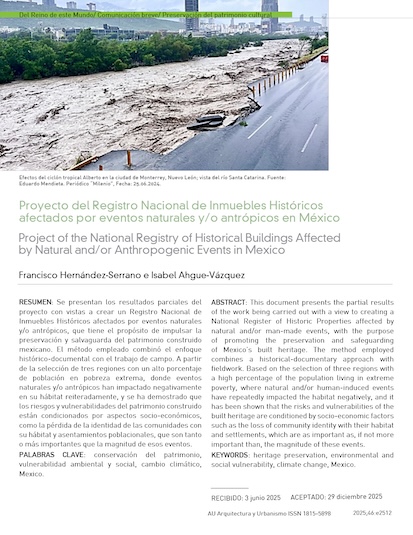
Project of the National Registry of Historical Buildings Affected by Natural and/or Anthropogenic Events in Mexico
Keywords:
heritage preservation, environmental and social vulnerability, climate change, MexicoAbstract
This document presents the partial results of the work being carried out with a view to creating a National Register of Historic Properties affected by natural and/or man-made events, with the purpose of promoting the preservation and safeguarding of Mexico's built heritage. The method employed combines a historical-documentary approach with fieldwork. Based on the selection of three regions with a high percentage of the population living in extreme poverty, where natural and/or human-induced events have repeatedly impacted the habitat negatively, and it has been shown that the risks and vulnerabilities of the built heritage are conditioned by socio-economic factors such as the loss of community identity with their habitat and settlements, which are as important as, if not more important than, the magnitude of these events.
References
[1] Consejo Nacional de Evaluación de la Política de Desarrollo Social. Informe de Evaluación de la Política de Desarrollo Social 2024. México: CONEVAL; 2024 [consultado: 23 de junio de 2025]. Disponible en: https://www.coneval.org.mx/EvaluacionDS/PP/CEIPP/Documents/Informes/IEPDS_2024.pdf
[2] Marambio Castillo A, Romano Grullón Y, Crespo Blanco MC, Colanino N. Guía Metodológica: Elaboración y Actualización de Programas Municipales de Desarrollo Urbano (PMDUs). Ciudad de México: SEDATU/SEMARNAT/GIZ; 2017 [consultado: 23 de junio de 2023]. Disponible en: https://www.gob.mx/cms/uploads/attachment/file/484508/04_02_1.2_PMDU2017_Guiametodologica.pdf
[3] Secretaría Interinstitucional de la Estrategia Internacional para la Reducción de Desastres, Naciones Unidas. Vivir con el riesgo. Informe mundial sobre iniciativas para la reducción de desastres [Internet]. Ginebra: EIRD/ONU; 2004 [consultado: 24 de octubre 2024]. Disponible en: https://www.eird.org/vivir-con-el-riesgo/index2.htm
[4] Plan Nacional de Desarrollo. Gobierno de México. 2019-2024. Ciudad de México: Gobierno de México; 2019. https://framework-gb.cdn.gob.mx/landing/documentos/PND.pdf
[5] Nicolescu B. La Transdisciplinariedad. Manifiesto. México: Saberes; 1996. Disponible en: https://edgarmorinmultiversidad.org/index.php/descarga-libro-la-transdiciplinariedad-en-manifiesto.html
[6] Centro Nacional de Prevención de Desastres (CENAPRED). Peligros naturales y tecnológicos relevantes durante el periodo de 1810 a 2010. Información documental sobre los eventos más significativos 1810-2010 [Internet]. Ciudad de México: CENAPRED; 2010 [actualizado 2013]. Disponible en: http://www.atlasnacionalderiesgos.gob.mx/archivo/archivo/documentos/Peligros_Naturales_Tecnologicos_1810_2010.pdf
[7] Consejo Nacional de Evaluación de la Política de Desarrollo Social (CONEVAL). Lineamientos y criterios generales para la definición, identificación y medición de la pobreza [Internet]. México: CONEVAL; 2010 Jun 16 [consultado: 23 de junio de 2023]. Disponible en: https://www.coneval.org.mx/rw/resource/coneval/med_pobreza/DiarioOficial/DOF_lineamientos_pobrezaCONEVAL_16062010.pdf
[8] Silva Ortiz LM. Crónica de Seis Siglos de Sismos en México: lecciones aprendidas y perspectivas. Ciudad de México: Asociación Mexicana de Instituciones de Seguros, A.C.; 2019 [consultado: 23 de marzo de 2023]. Disponible en: https://amissegurodevivienda.com/wp-content/uploads/2022/10/LIBRO-SISMOS-2019.pdf
[9] Ahgue Vázquez I, Hernández Serrano F. Entre la especulación, usufructo y conservación; Nuevos imaginarios y destrucción del Barrio Antiguo y Santa Lucia en Monterrey. En: Delgadillo V, Niglio O. (eds.). El asedio inmobiliario y turístico al patrimonio urbano. Roma: tab edizioni; 2022. pp. 277-314.
[10] Gómez Robles L. Los valores del monumento restaurado. Una aproximación a la restauración científica. Revista PH [Internet]. 2010 [consultado: 23 de junio de 2023]; (75):80-93. Disponible en: https://doi.org/10.33349/2010.75.3017
[11] Aceves García S, Alcántara Onofre S. Patrimonio en Riesgo. La consecuencia de los sismos en el patrimonio edificado. Revista América Patrimonio. 2011; (2)
[12] Di Bitetti MS. ¿Qué es el hábitat? Ambigüedad en el uso de la jerga técnica. Ecología Austral [Internet]. 2012 [consultado: 23 de junio de 2023]; 22(2):137-143. Disponible en: https://ojs.ecologiaaustral.com.ar/index.php/Ecologia_Austral/article/view/1257
[13] Arellano Hernández A. Hacia una antropología del conocimiento atmosférico y del cambio climático. Antropología. Revista interdisciplinaria del INAH [Internet]. 2024 [consultado: 23 de junio de 2023]; (13):24-40. Disponible en: https://revistas.inah.gob.mx/index.php/antropologia/article/view/21106
[14] Martínez Viveros E. Inteligencia Geoespacial para desastres sísmicos: Investigaciones en CentroGEO. Revista Mexicana de Sociología [Internet]. 2018 [consultado: 23 de junio de 2023]; 80(spe):71-94. Disponible en: https://doi.org/10.22201/iis.01882503p.2018.0.57774
[15] Hernández Serrano F. Risks and socio-cultural impacts in the Sierra Tarahumara, State of Chihuahua. In: Heritage at Risk World Report 2016-2019 on monuments and sites in danger. Regensburg (Germany): Bäßler Verlag, ICOMOS, UNESCO; 2020.
Downloads
Published
How to Cite
Issue
Section
License
Copyright (c) 2026 Revista científica de Arquitectura y Urbanismo

This work is licensed under a Creative Commons Attribution-NonCommercial-NoDerivatives 4.0 International License.
a. The authors retain the copyright and guarantee the magazine the right to be the first publication of the work as well as a Creative Commons Attribution License that allows others to share the work with an acknowledgment of the authorship of the work and the initial publication in this magazine.
b. Authors may separately establish additional agreements for the non-exclusive distribution of the version of the work published in the journal (for example, place it in an institutional repository or publish it in a book), with an acknowledgment of its initial publication in this journal.
c. Authors are allowed and encouraged to disseminate their work electronically (for example, in institutional repositories or on their own website) before and during the submission process, as it can lead to productive exchanges, as well as a more early and major published papers (See The Effect of Open Access, in English).
