
Digital Echoes in Contemporary Architecture: A Phenomenological Study of Four Disruptive Experimental Projects
Keywords:
phenomenological architecture, new technologies, contemporary architecture, interaction with the environment, digital systemsAbstract
This study addresses the impact of digital technologies on contemporary architecture, highlighting how sensors, virtual reality, augmented reality and sensitive facades have transformed sensory interaction in built space. The main objective is to analyse how these technologies go beyond their practical function, generating spaces that stimulate the senses and integrate with the environment. A taxonomy is used to classify four disruptive experimental architectural projects from the early 21st century, demonstrating how digital technologies have evolved from a static view to a more complex perspective. The study argues that digital systems have become a new design material, expanding creativity and highlighting the importance of sensory and emotional experience in the design process. Preliminary findings suggest that technology plays a crucial role in the creation of meaningful architectural spaces.
References
Nesbitt K. Theorizing a New Agenda for Architecture: An Anthology of Architectural Theory 1965-1995. New York: Princeton Architectural Press; 1996.
Holl S. Phenomena and Idea. GA Architect. 1993; 11(Tokyo):12-17.
Carpo M. La arquitectura digital inteligente tiene poco que ver con los computadores (y menos aún con su inteligencia). ARQ (Santiago) [Internet]. 2023 [consultado: 10 de enero de 2024]; (113):18-31. Disponible en: http://dx.doi.org/10.4067/S0717-69962023000100018.
Morin E. El Método 4: Las ideas. Madrid: Cátedra; 2006.
Marcos CL, Fernández-Álvarez AJ. Más allá de los datos. La información como material de diseño. En: Libro de Ponencias: XIX Congreso Internacional de Expresión Gráfica Arquitectónica. Cartagena; Universidad Politécnica de Cartagena; 2022. p. 309-312.
Fernández Galiano L. Placeres del pliegue. La última vanguardia holandesa. Arquitectura Viva. 1998;(69).
Zátonyi M. Juglares y Trovadores: derivas estéticas. Buenos Aires: Capital Intelectual; 2011.
Mileto C. La conservación de la arquitectura: materia y mensaje sensibles. Loggia: Arquitectura y restauración. 2006; (19):20-33.
Alda Esparza FJ. Del mapa como objeto al posthumanismo tecno-fenomenológico. AusArt [Internet]. 2022 [consultado: 10 de enero de 2024]; 10(2):21-35. Disponible en: https://doi.org/10.1387/ausart.23931.
Rosado-García M, García-García M. La ingeniería como territorio común del arte, la ciencia y la tecnología. Una respuesta fenomenológica. Arbor [Internet]. 2022 [consultado: 10 de enero de 2024]; 198(806):a684. Disponible en: https://doi.org/10.3989/ARBOR.2022.806014.
Orangevoid. Píxel Skin. Transmaterial, 2009. [Consultado: 10 de enero de 2024]. Disponible en: http://transmaterial.net/.
ANNEXNube De Datos Entrelazados. Metalocus, 21 noviembre de 2021. [Consultado: 10 de enero de 2024]. Disponible en: https://www.metalocus.es/es/noticias/nube-de-datos-entrelazados-pabellon-de-irlanda-en-la-17a-edicion-de-la-biennale-di-venezia-por-annex.
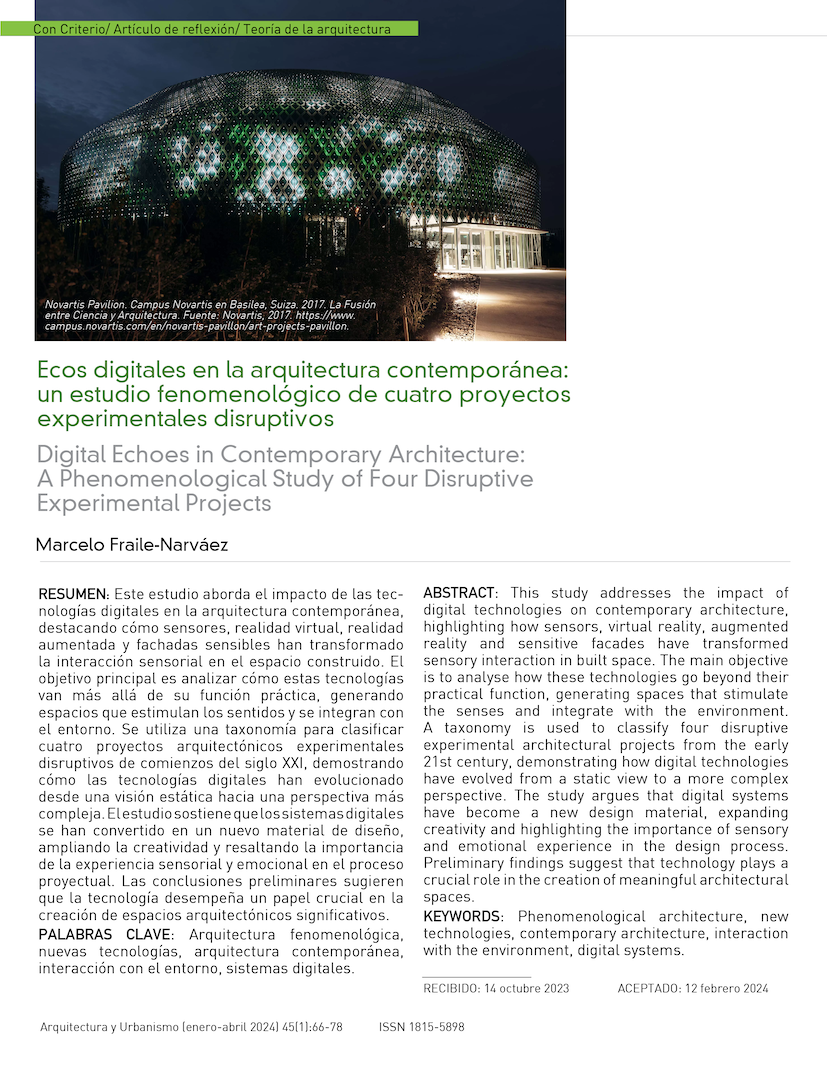
AMDL CIRCLE. Art Projects for the Novartis Pavillon. Novartis Campus, 2017. [Consultado: 10 de enero de 2024]. Disponible en: https://www.campus.novartis.com/en/novartis-pavillon/art-projects-pavillon.
Zumthor P. Pensar en Arquitectura. Barcelona: GG; 2009.
Diller E, Scofidio R, Renfro R. (2022). Braincoat. [Consultado: 10 de enero de 2024]. Disponible en: https://dsrny.com/project/blur-braincoat
DILLER SCOFIDIO + RENFRO. Blur Building. Swiss Expo 2002, Yverdon - Les- Bains, Switzerland. DS + R, 2002. [Consultado: 10 de enero de 2024]. Disponible en: https://dsrny.com/project/blur-building
Fuster Guillen DE. Investigación cualitativa: Método fenomenológico hermenéutico. Propósitos y Representaciones [Internet]. 2019 [consultado: 10 de enero de 2024]; 7(1):201-29. Disponible en: https://dx.doi.org/10.20511/pyr2019.v7n1.267.
Sandes F, Estrada C, Pestanha G, Potichkin M, Sosa M, Vanrrell A. Fenomenología arquitectónica en la formulación del programa de diseño. Cuadernos del Centro de Estudios en Diseño y Comunicación [Ensayos]. 2022 [consultado: 10 de enero de 2024]; (167):145-54. Disponible en: https://doi.org/10.18682/cdc.vi167.7069.
Downloads
Published
How to Cite
Issue
Section
License
Copyright (c) 2024 Revista científica de Arquitectura y Urbanismo

This work is licensed under a Creative Commons Attribution-NonCommercial-NoDerivatives 4.0 International License.
a. The authors retain the copyright and guarantee the magazine the right to be the first publication of the work as well as a Creative Commons Attribution License that allows others to share the work with an acknowledgment of the authorship of the work and the initial publication in this magazine.
b. Authors may separately establish additional agreements for the non-exclusive distribution of the version of the work published in the journal (for example, place it in an institutional repository or publish it in a book), with an acknowledgment of its initial publication in this journal.
c. Authors are allowed and encouraged to disseminate their work electronically (for example, in institutional repositories or on their own website) before and during the submission process, as it can lead to productive exchanges, as well as a more early and major published papers (See The Effect of Open Access, in English).
